

Trigonometric Functions
Recall that a real number  can be interpreted as the measure of the angle constructed as follows: wrap a piece of string of length units around the unit circle
  (counterclockwise if
  , clockwise if
  ) with initial point P(1,0) and terminal point Q(x,y). This gives rise to the central angle with vertex O(0,0) and sides through the points P and Q. All six trigonometric functions of are defined in terms of the coordinates of the point Q(x,y), as follows:

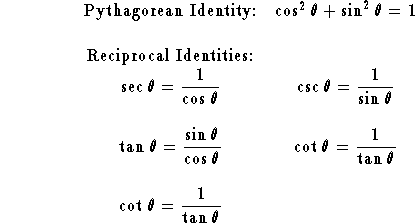
Since Q(x,y) is a point on the unit circle, we know that . This fact and the definitions of the trigonometric functions give rise to the following fundamental identities:
This modern notation for trigonometric functions is due to L. Euler (1748).
More generally, if Q(x,y) is the point where the circle  of radius R is intersected by the angle , then it follows (from similar triangles) that

Periodic Functions
If an angle corresponds to a point Q(x,y) on the unit circle, it is not hard to see that the angle  corresponds to the same point Q(x,y), and hence that

Moreover,  is the smallest positive angle for which Equations 1 are true for any angle . In general, we have for all angles :

We call the number the period of the trigonometric functions  and
and  , and refer to these functions as being periodic. Both
  and
and  are periodic functions as well, with period , while
  and
and  are periodic with period
  .
.
EXAMPLE 1 Find the period of the function  .
.
Solution: The function runs through a full cycle when the angle 3x runs from 0 to , or equivalently when x goes from 0 to  . The period of f(x) is then

